Located at 266 Cumberland Street in the heart of Fort Greene, the Sanctuary Condominiums stand as a compelling example of how thoughtful architecture can bridge the past to the present. This 20th-century Neo-Gothic church, long abandoned, along with its rectory building, is situated in the heart of the landmark district of Fort Greene. Situated on Cumberland Avenue, between Lafayette and DeKalb Avenues, it is also near Fort Greene Park.
Designed by Scarano Architect, PLLC, this project demonstrates the transformative power of adaptive reuse-turning a long-abandoned religious structure into vibrant, modern religious structure into vibrant, modern residential space while preserving its historic character.
A Historic Foundation Reimagined
Originally constructed in 1915 as Our Lady of Pillar Catholic Church, the building and attached rectory have housed various churches over the years. 264-266 Cumberland Street served multiple congregations before being abandoned in the early 2000’s. Its vacancy had a noticeable impact on the surrounding neighborhood, contributing to a sense of stagnation along the street. The challenge and opportunity was to reintroduce purpose to a structure rich in architectural and cultural significance.
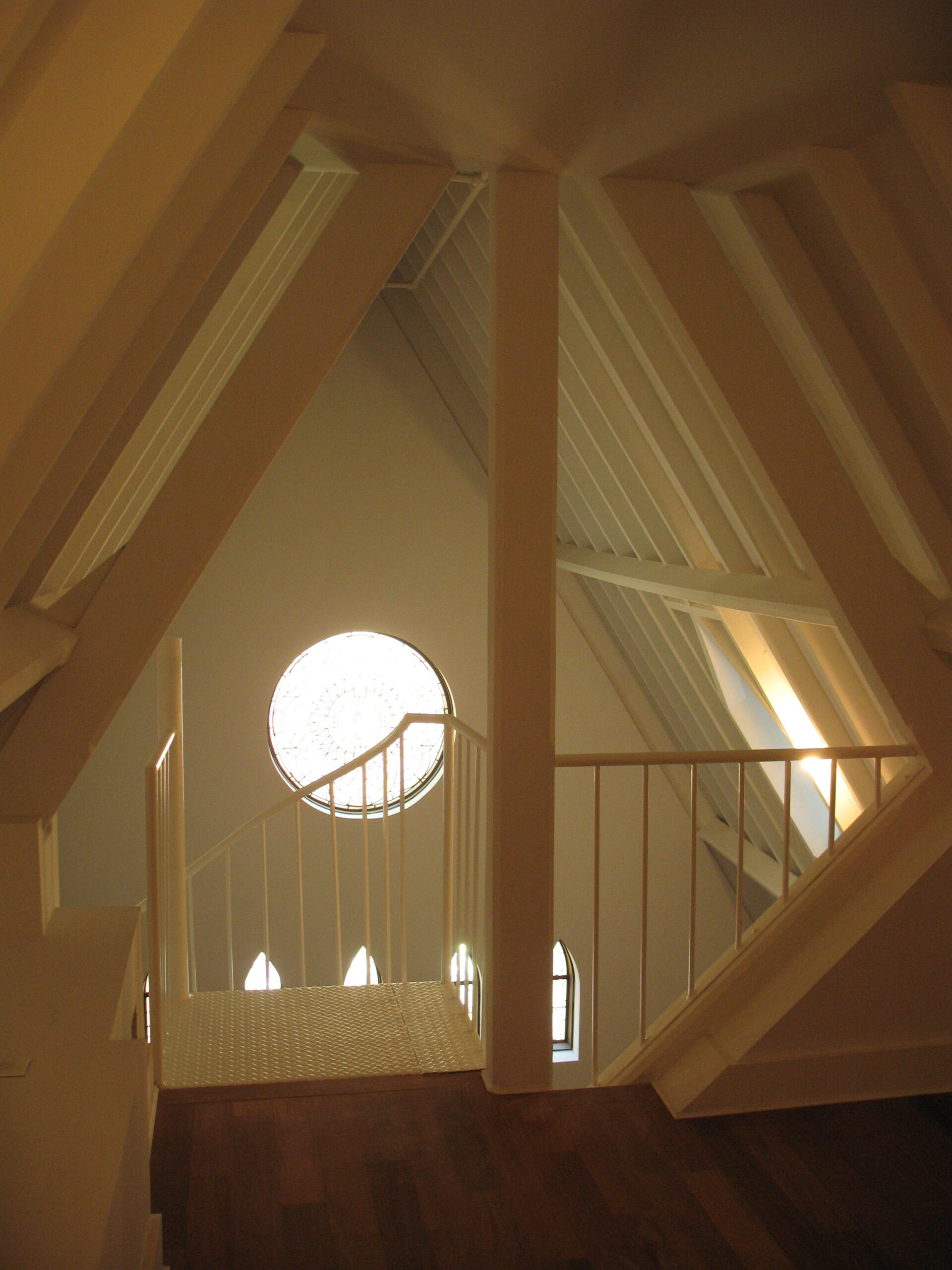
The two attached four-story buildings have been designed to include thirteen apartments, and each building uses an organic aspect of the church, from the beamed ceilings throughout to the arches in the main sanctuary. A rooftop extension was designed to maximize the property’s potential while maintaining a discreet profile from the street.
The central concept was twofold: convert a spiritual place into modern residences while fully respecting their functional utilitarian needs, and second, to preserve the unique aura of the space and its surroundings. Together, these two concepts enable the new use of the old structure to become an organic part of the streetscape. During the alteration, new light-framed partitions and walls were
installed without compromising the original basilica structure, which remains the building’s core. On the upper floors, original Gothic roof rafters and braces are fully exposed, which, in combination with the rose-stained-glass windows, communicate each apartment’s unique grandeur.
Scarano Architect, PLLC, approached the project with a sharp vision: retain the spiritual and architectural essence of the original Neo-Gothic church while adapting it to meet contemporary residential needs. Completed in 2008, the development now consists of thirteen uniquely designed condominium units housed within the former church and its adjoining rectory.
The Essence of Adaptive Reuse
The Sanctuary Condominiums exemplify adaptive reuse at its most effective. Rather than demolishing the existing structure, the design preserves key architectural features-such as exposed timber beams, Gothic arches, and stained-glass windows-integrating them into modern living spaces.
New interventions were carefully calibrated: light-frame partitions were inserted without compromising the original basilica structure, allowing the historic framework to remain legible and central to the design. The addition of a discreet rooftop extension further maximized usable space while maintaining the building’s historic street presence.
This approach reflects a broader architectural philosophy-one that values continuity over replacement. By working with the existing fabric, Scarano Architect, PLLC, not only reduced material waste but also preserved the narrative embedded within the building’s walls.
Design That Honors Context
Situated within the Fort Greene Historic District, the project required sensitivity to both architectural heritage and community context. The restored façade maintains the integrity of the original church, ensuring that the building continues to contribute to the neighborhood’s historic streetscape.
Inside, however, the experience is distinctly contemporary. Residences feature open layouts, lofty ceilings, and abundant natural light qualities enhanced by the building’s original ecclesiastical volume. The juxtaposition of old and new creates spaces that are both visually striking and highly livable.
Community Impact and Architectural Significance
Adaptive reuse projects like the Sanctuary Condominiums play a critical role in urban revitalization. The conversion of a dormant structure into active residential use has re-energized its immediate surroundings, contributing to the ongoing evolution of Fort Greene as one of Brooklyn’s most desirable neighborhoods.
Moreover, the project reinforces the idea that preservation and progress are not mutually exclusive. By maintaining the building’s historic identity while introducing new functionality, Scarano Architect, PLLC, has created a model for sustainable urban development-one that respects the past while accommodating the needs of the present.
A Signature of Scarano Architect, PLLC
Known for its extensive portfolio of residential and adaptive reuse projects, Scarano Architect, PLLC, has consistently demonstrated an ability to navigate the complexities of working in New York City’s dense, historically layered environment. The Sanctuary Condominiums encapsulate this expertise, highlighting the firm’s commitment to design innovation, preservation, and community-oriented development.
Conclusion
The Sanctuary Condominiums at 266 Cumberland Street are more than a residential development-they are a testament to the enduring value of adaptive reuse. Through careful design and respect for historical context, Scarano Architect, PLLC, has transformed a once-abandoned church into a dynamic living environment, enriching both the architectural landscape and the community it serves.
Please visit our website to view this historic building as well as our other projects.