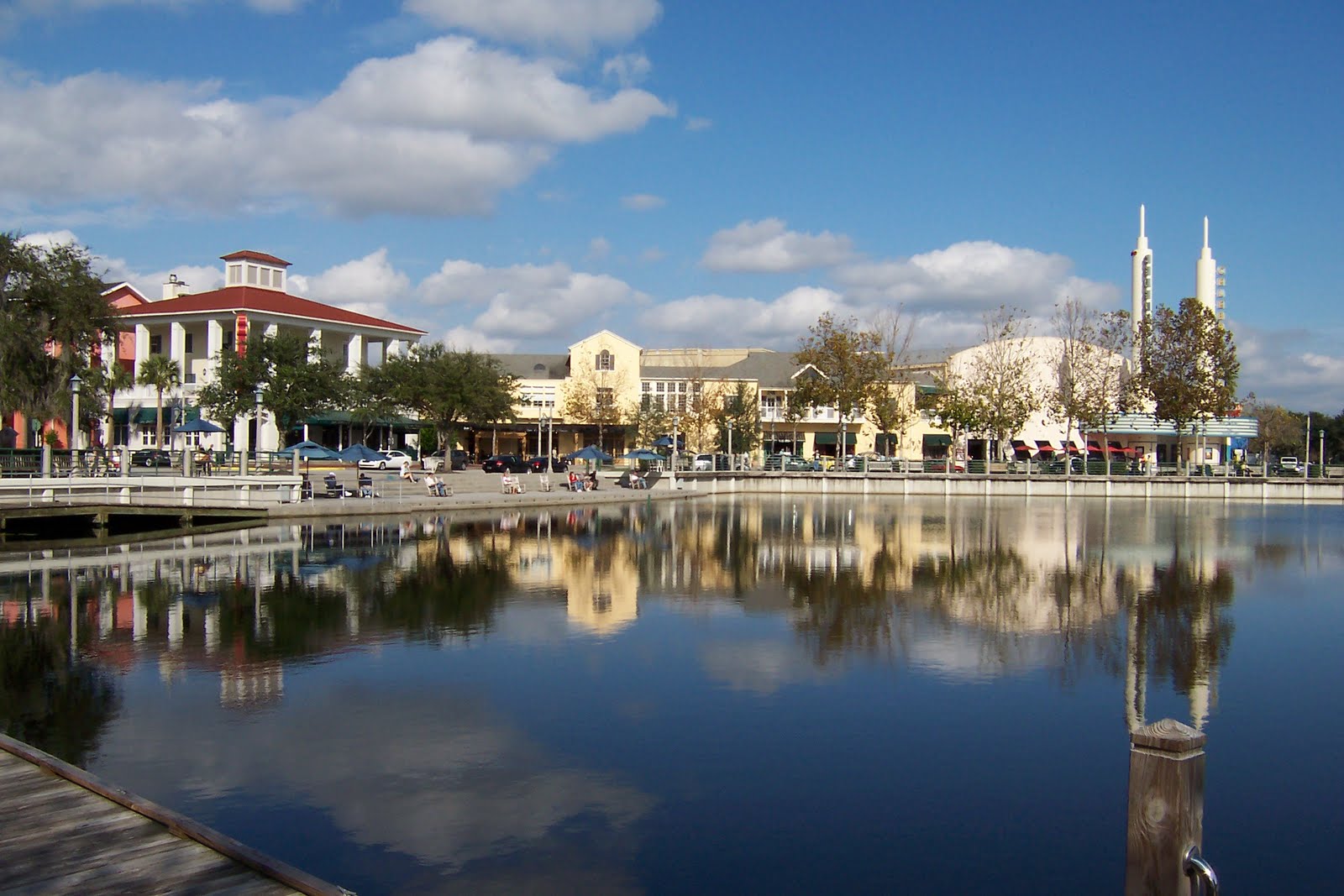
Most architects are asked to design a building. In Celebration, Florida, architects were given a much larger challenge: to help create an entire town.
Developed by the Walt Disney Company beginning in the 1990’s, Celebration became one of the most discussed planned communities in the United States. Instead of approaching the project as a collection of individual buildings, its planners and architects considered how homes, streets, sidewalks, parks, stores, civic buildings, and public spaces could work together to create a recognizable community.
For architects, Celebration remains an interesting case study because it raises a fundamental question: Can architects deliberately create the qualities that make a town feel as though it developed naturally over generations?
Designing a Town, Not Just Buildings
Architecture is often discussed one building at a time. Celebration demonstrates why architects also need to think beyond the walls of an individual project.
The relationship between buildings can have an enormous influence on how people experience a place. Street width, sidewalks, landscaping, building setbacks, porches, storefronts, parks, and public gathering areas all contribute to the character of the neighborhood.
In other words, the spaces between buildings can be just as important as the buildings themselves.
Celebration was planned around this idea. Rather than separating residential neighborhoods, shopping areas, and civic functions into distant zones connected primarily by automobiles, the community was intended to bring many of these activities closer together.
Celebration and New Urbanism
Celebration became closely associated with the principles of New Urbanism, a planning movement that sought to revive characteristics found in traditional American towns.
For much of the twentieth century, suburban development increasingly separated houses from shopping, employment, and public spaces. Wide roads, large parking areas, and automobile-oriented development often replaced the compact streets and walkable neighborhoods of older towns.
New Urbanism proposed another approach.
Neighborhoods could once again include sidewalks, porches, parks, shops, and civic spaces within relatively close proximity. Streets could become places for people rather than simply routes for automobiles. Buildings could help define public spaces instead of sitting behind enormous parking lots.
Celebration attempted to translate many of these ideas into a functioning community.
A Town Shaped by Different Architects
One of the most fascinating aspects of Celebration is the number of prominent architects who contributed to the community.
The master planning was led by architects Robert A.M. Stern and Jacquelin Robertson, while several well-known architects were invited to design important civic and commercial buildings.
Among those associated with Celebration were Michael Graves, Philip Johnson, Cesar Pelli, Robert Venturi and Denise Scott Brown, and Charles Moore.
That created an unusual architectural experiment.
Instead of asking one architect to design every detail, Celebration allowed architects with different philosophies to contribute individual buildings while working within the town’s larger vision.
The result demonstrates how architecture can accommodate individuality while still contributing to a larger urban composition.
A building does not exist by itself. Its scale, entrance, materials, windows, and relationship to the street affect everything around it. Celebration makes those relationships particularly easy to observe because so much of the community was conceived as part of a coordinated plan.
Looking to the Past to Design for the Present
Celebration also raises interesting questions about architectural history.
Many of its houses draw inspiration from traditional American architectural styles. Porches, pitched roofs, shutters, columns, and familiar residential proportions appear throughout the community.
Critics have sometimes questioned whether communities designed in this manner rely too heavily on nostalgia. Supporters, however, point to the human scale and neighborhood qualities that traditional town planning can provide.
For architects, the more useful lessons may lie somewhere beyond the debate over architectural style.
Historic communities developed many practical strategies long before the automobile became dominant. Porches created transitions between private homes and public streets. Windows provided natural light and ventilation; trees shaded sidewalks. Compact neighborhoods made walking practical.
Studying traditional architecture does not necessarily mean copying the past. It can mean understanding why certain design ideas worked and determining how to adapt them to contemporary life.
Architectural Guidelines and Community Character
Another important part of Celebration’s development was the use of architectural guidelines.
When an entire neighborhood is being planned, architects must balance individual expression with the visual continuity of the larger community.
Without any coordination, buildings may have little relationship to one another. Too much control, however, can produce neighborhoods that feel overly uniform.
Celebration sought to establish a recognizable architectural character while still allowing for variations among buildings and homes.
This is an issue architects encounter in many projects today, particularly in historic districts, planned developments, condominium projects, and mixed-use communities.
Superior design requires understanding both the individual building and its context.
Architecture Must Respond to Climate
Celebration is also a reminder that architecture must respond to geography and climate.
Florida’s intense sunlight, heat, humidity, and heavy rainfall create vastly different architectural requirements from those encountered in New York or the Northeast.
Deep roof overhangs, porches, shade, landscaping, and appropriate building materials can all contribute to comfort and durability.
Traditional architecture frequently evolved in response to local climate. Before mechanical heating and air-conditioning became commonplace, buildings depended heavily on orientation, ventilation, shade, and construction techniques suited to their environment.
Modern architects have increasingly returned to many of these principles as energy efficiency and sustainable architecture become more important.
What Celebration Can Teach Architects Today
More than three decades after its creation, Celebration continues to offer lessons about planning and architecture.
Perhaps the most important thing is that successful communities are not created by buildings alone.
People experience architecture while walking down a sidewalk, sitting in a park, entering a store, looking from a porch, or meeting neighbors in a public space. The quality of those experiences depends on countless design decisions.
Celebration also demonstrates the importance of architectural placemaking—using buildings and public spaces together to create a recognizable sense of place.
This concept has become increasingly important as cities reconsider suburban development, downtown districts, obsolete shopping centers, and large single-use properties. Architects are being asked to think about how these places can become more walkable, adaptable, and connected.
The lessons of Celebration therefore extend far beyond Florida.
The Scarano Architect Perspective
At Scarano Architect, PLLC, studying communities such as Celebration is part of understanding architecture in a broader context.
Every project—whether a residence, renovation, adaptive reuse project, restaurant, commercial property, or larger development—exists within a neighborhood and affects the people who experience it.
For an architectural practice working in New York City and the Northeast, Celebration may seem geographically distant, but many of its underlying design questions are remarkably relevant.
How should a building meet the street? How can architecture encourage interaction? How can older architectural ideas be adapted rather than simply copied? How can buildings respond intelligently to climate and changing lifestyles? And how can an individual project contribute positively to the larger community?
These questions are not limited to planned towns. They are fundamental questions of architecture.
Celebration remains noteworthy because architects and planners were given an unusual opportunity to address them at the scale of an entire community.
Whether one admires every architectural decision or questions aspects of the experiment, Celebration provides something extremely valuable: a place where architects can study how planning, architecture, landscape, and public space interact.
Ultimately, that may be Celebration’s most enduring architectural lesson. Architects do not simply design buildings—they help design the places in which life happens.